Roz Chast is one of my favorite New Yorker cartoonists, but this time, she delivered an insult.
"Crap somebody knitted"? Crap?
Roz must not be a knitter, or she would have more appreciation for the artistry, effort, and dogged determination required to produce a significant knitted creation.
I'm just now finishing a knitting project so time-consuming it makes the labor of Sisyphus look like taking out the trash. Roz, this is no crap, this is a creative effort requiring extensive commitment over a period of many months.
It was the winter of 2010, and I had pneumonia. I couldn't do much, but I could knit.
Lucia had been bugging me about knitting her an afghan.
"Julia and Leah got theirs when they started college." (Lucia had just started at the University of Vermont). "How come I don't have one?"
"Because I like Julia and Leah better!"
Still, despite the fact that Lucia and I sat down on several occasions to look at patterns and try to make some decisions about what I could make for her, there were too many choices, and our discussions always ended inconclusively.
So when the pneumonia sidelined me in the winter of 2010, I decided to use this period of inactivity to go ahead and start an afghan and surprise Lucia later with the finished product. I knew that this afghan had to use a lot of her favorite color, purple. I chose size six needles for all the blocks.
This is the book I decided to use. My goal: 48 afghan squares.
Squares were such an easy choice at the time. One square knits up so quickly. Sitting in my glider rocker, I could knit up 48 easily.
So I did.
Here's a look at a few of them:
This one's my favorite: colorful, sturdy, and easy to execute. My book calls it Up and Over.
This one took a whole lot of paying attention. The book calls it Lace Chevrons.
This one also took a lot of attention. The book calls this pattern Shutter. For it, I worked a color pattern by the intarsia method. For the first time. Whoo hoo!
This is another intarsia method block requiring a lot of attention. The book called it Big Heart.
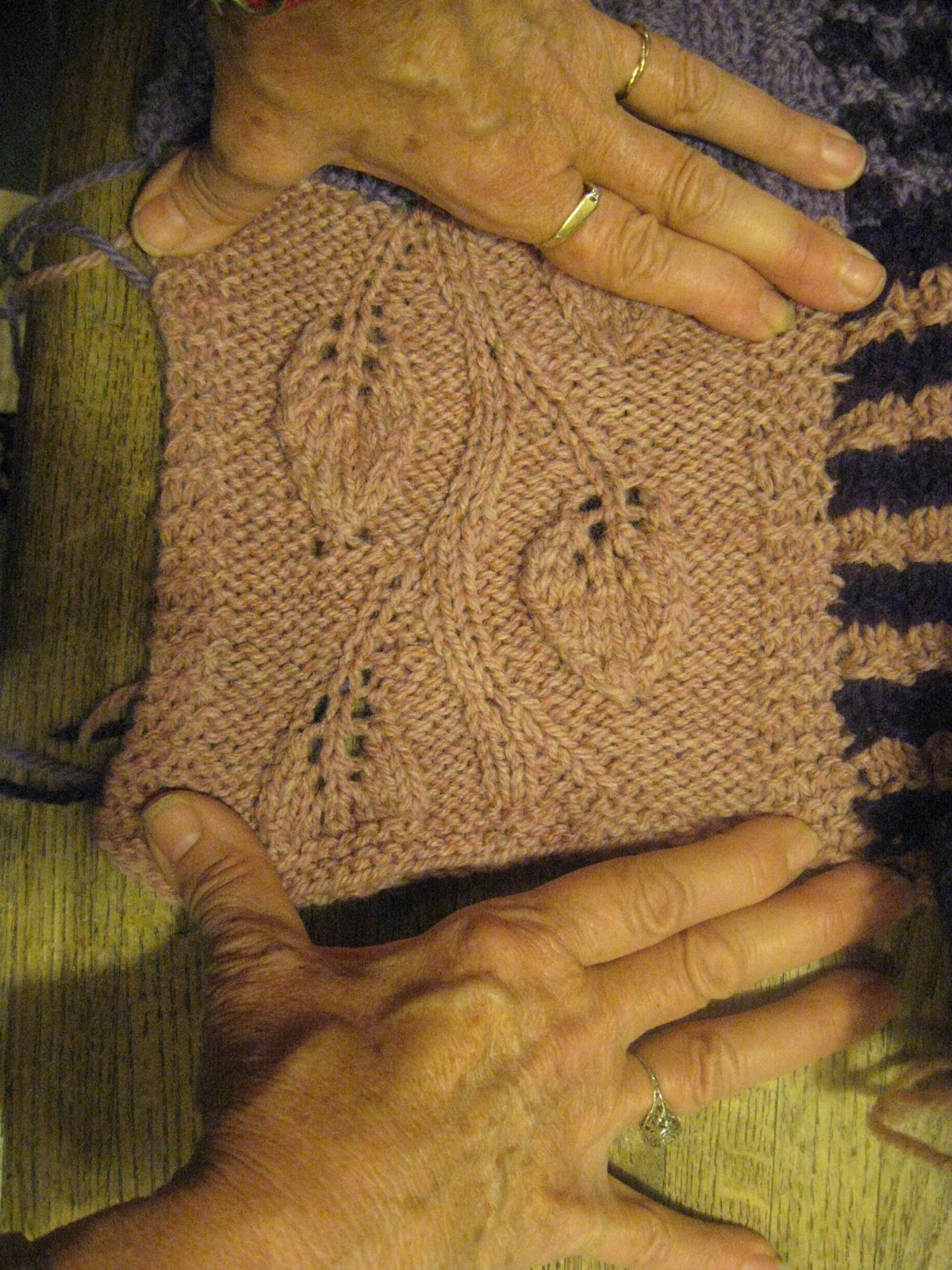
This one's my favorite: Embossed Twining Vine Leaf, a block adapted from a different book, Vogue Knitting.
Crap?
I think not.
The creation of these squares required a lot of skill.
Still, I have to say, sewing them together required a lot of determination, and that's where a good idea under pneumonia circumstances turned out to be a labor-intensive pain in the ass later.
That's why I'm calling this blog entry "Seemed Like a Good Idea at the Time Dept."
Roz, you have to respect the effort required to sew these 48 squares together, first, into pairs, then into eight rows of six squares each.
Did I mention the Sisyphus part yet?
I'm not a knitter with a whole lot of techniques in her tool pouch. I know only one way to sew two knitted items together: the mattress stitch.
Many thanks to Judy Perodeau of the late, great Needleworks, Newington, CT, who taught me this sturdy but time-consuming stitch.
The mattress stitch uses the concept of the shared hole.
Are you with me?
A shared hole is one through which the yarn and needle have already passed and will now pass again.
This is a shared hole:
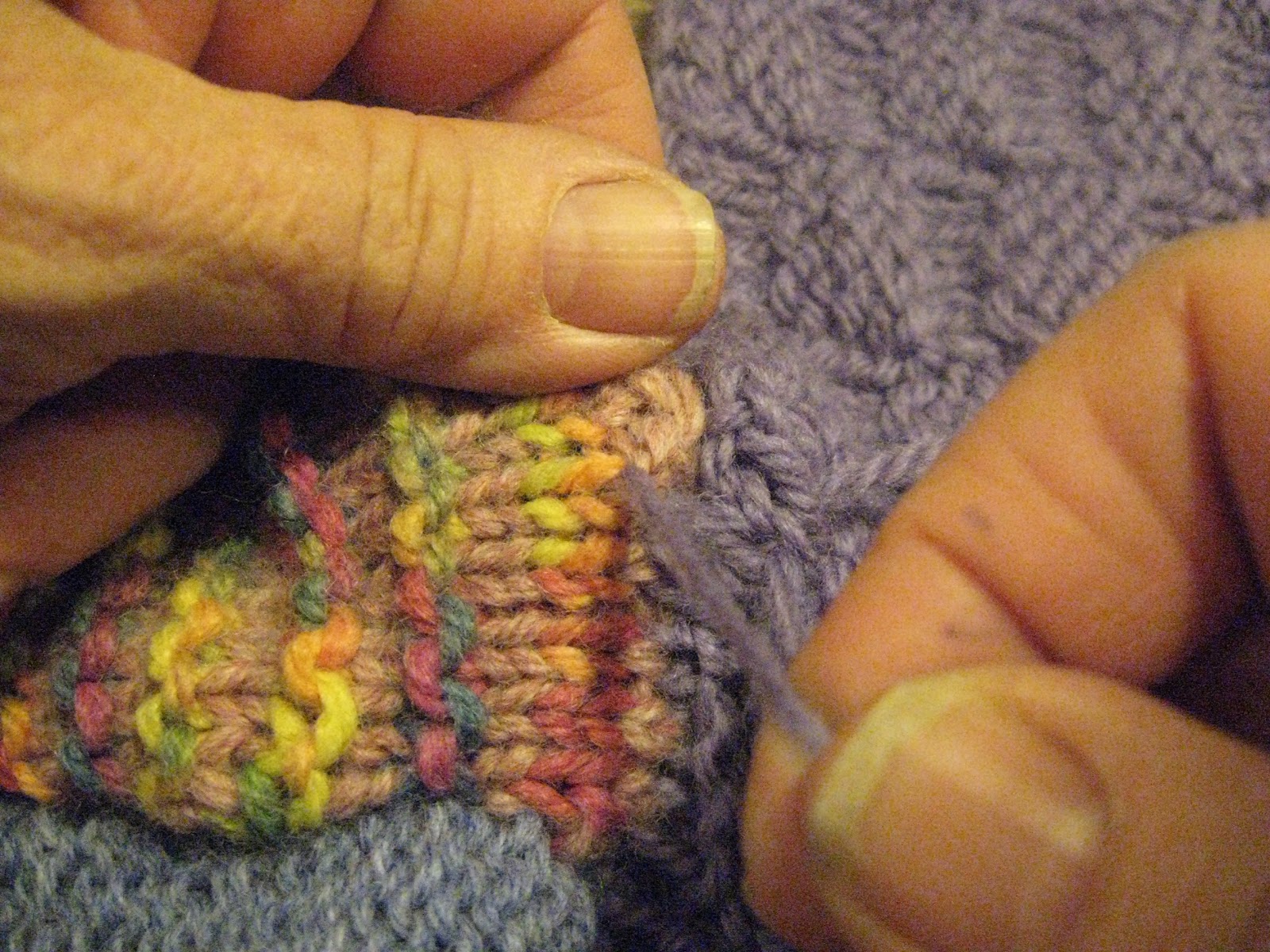
To execute a mattress stitch, you insert a needle into a shared hole, like so:
Once the needle goes into the shared hole, then it has to go up two stitches of the ladder. This is what "two stitches of the ladder" means.
Once the needle and yarn traverse these two stitches of the ladder, they have to go over to the other side, into the most recent shared hole on that side, and the journey begins again.
Once the squares and rows are laboriously sewn together, I have to deal with the fact that the reverse side of this afghan is a welter of hanging threads.
Did I mention Sisyphus?
This is how I feel as I drag this project to completion:
But who's complaining?
I'm stitching it all together: the legal journalist, the quilt artist, the mother, the gardener, the maker of curried egg salad and tabbouleh.
Thursday, October 27, 2011
Monday, October 3, 2011
The Volunteer Garden in its Glory
Posted by
Diane Cadrain
In the world of gardening, a volunteer is a plant that grows spontaneously, as opposed to one planted intentionally. I suppose weeds are classic volunteers. But weeds are in the eye of the gardener. Some weeds are otherwise known as wildflowers, and like goldenrod (solidago), they can be lovely blessings in places where nothing else will grow.
Thus, the volunteer garden.
Along the side of my driveway, there's a hellish strip about 10 inches wide, backed up by a wooden fence, and flanked by a similar strip in our neighbors' yard on the other side of the fence. Both strips are bordered by the asphalt of our driveways, and as such, they're undergirded with gravel and topped with an inch or so of the unforgiving clay that forms our soil here in CT. Whatever can grow in a narrow strip backed up by a fence and based on clay and rubble?
I wondered that myself. I wanted to plant something there, but what the heck would grow in such a forbidding zone?
Nature showed me.
A few years ago, some thyme plants leapt over from my nearby raised bed and established themselves there, followed by some lambs' ears.
If those volunteers would grow there spontaneously, then maybe I could plant other hardy plants there intentionally--plants that cheerfully grow wherever they land.
Realizing that, I decided to plant, in that nasty strip, some of the plants that are the biggest, most invasive pains in the ass in an intentional garden. Solidago Fireworks, otherwise known as goldenrod, is a hugely invasive plant in places where you don't want it. Here's a look at its tenacious self, last spring, when I was uprooting it from another small garden in my yard where it wasn't wanted:
The leaves sprouted on the two ends, left and right, but they were joined under the ground by fibrous roots so tenacious that I fell on my ass more than once while trying to pull them out. Until I fell on my ass, I had been planning to separate these plants, pot them, and put them on my front steps, with a sign, inviting my neighbors to take them. But when they knocked me over, I decided they were far too impolite to be treated so nicely, so I put them in biodegradable paper bags and took them to our town landfill, where they would become compost.
Still, I recognize the virtues of goldenrod, and its very tenacity is the exact characteristic that makes it an excellent candidate for the volunteer garden. I'll say the same of Eupatorium Colestinum, a plant provided by my gardening friend Paula Mooney, and the Grandpa Ott morning glory, a plant that reappears every single year in my garden for at least 10 years since the one single time I planted it intentionally.
You have to love plants that tenacious. Especially if they're beautiful. And especially if they'll grow in a harsh environment where nothing else will.
Thus, the volunteer garden.
Along the side of my driveway, there's a hellish strip about 10 inches wide, backed up by a wooden fence, and flanked by a similar strip in our neighbors' yard on the other side of the fence. Both strips are bordered by the asphalt of our driveways, and as such, they're undergirded with gravel and topped with an inch or so of the unforgiving clay that forms our soil here in CT. Whatever can grow in a narrow strip backed up by a fence and based on clay and rubble?
I wondered that myself. I wanted to plant something there, but what the heck would grow in such a forbidding zone?
Nature showed me.
A few years ago, some thyme plants leapt over from my nearby raised bed and established themselves there, followed by some lambs' ears.
If those volunteers would grow there spontaneously, then maybe I could plant other hardy plants there intentionally--plants that cheerfully grow wherever they land.
Realizing that, I decided to plant, in that nasty strip, some of the plants that are the biggest, most invasive pains in the ass in an intentional garden. Solidago Fireworks, otherwise known as goldenrod, is a hugely invasive plant in places where you don't want it. Here's a look at its tenacious self, last spring, when I was uprooting it from another small garden in my yard where it wasn't wanted:
The leaves sprouted on the two ends, left and right, but they were joined under the ground by fibrous roots so tenacious that I fell on my ass more than once while trying to pull them out. Until I fell on my ass, I had been planning to separate these plants, pot them, and put them on my front steps, with a sign, inviting my neighbors to take them. But when they knocked me over, I decided they were far too impolite to be treated so nicely, so I put them in biodegradable paper bags and took them to our town landfill, where they would become compost.
Still, I recognize the virtues of goldenrod, and its very tenacity is the exact characteristic that makes it an excellent candidate for the volunteer garden. I'll say the same of Eupatorium Colestinum, a plant provided by my gardening friend Paula Mooney, and the Grandpa Ott morning glory, a plant that reappears every single year in my garden for at least 10 years since the one single time I planted it intentionally.
You have to love plants that tenacious. Especially if they're beautiful. And especially if they'll grow in a harsh environment where nothing else will.
| Grandpa Ott morning glories, Eupatorium Coelestinum, and Solidago Fireworks--the volunteer garden in its glory |
| Nothing else will grow here! But goldenrod will. |
Sunday, September 4, 2011
Zany Doings in the Name of Art
Posted by
Diane Cadrain
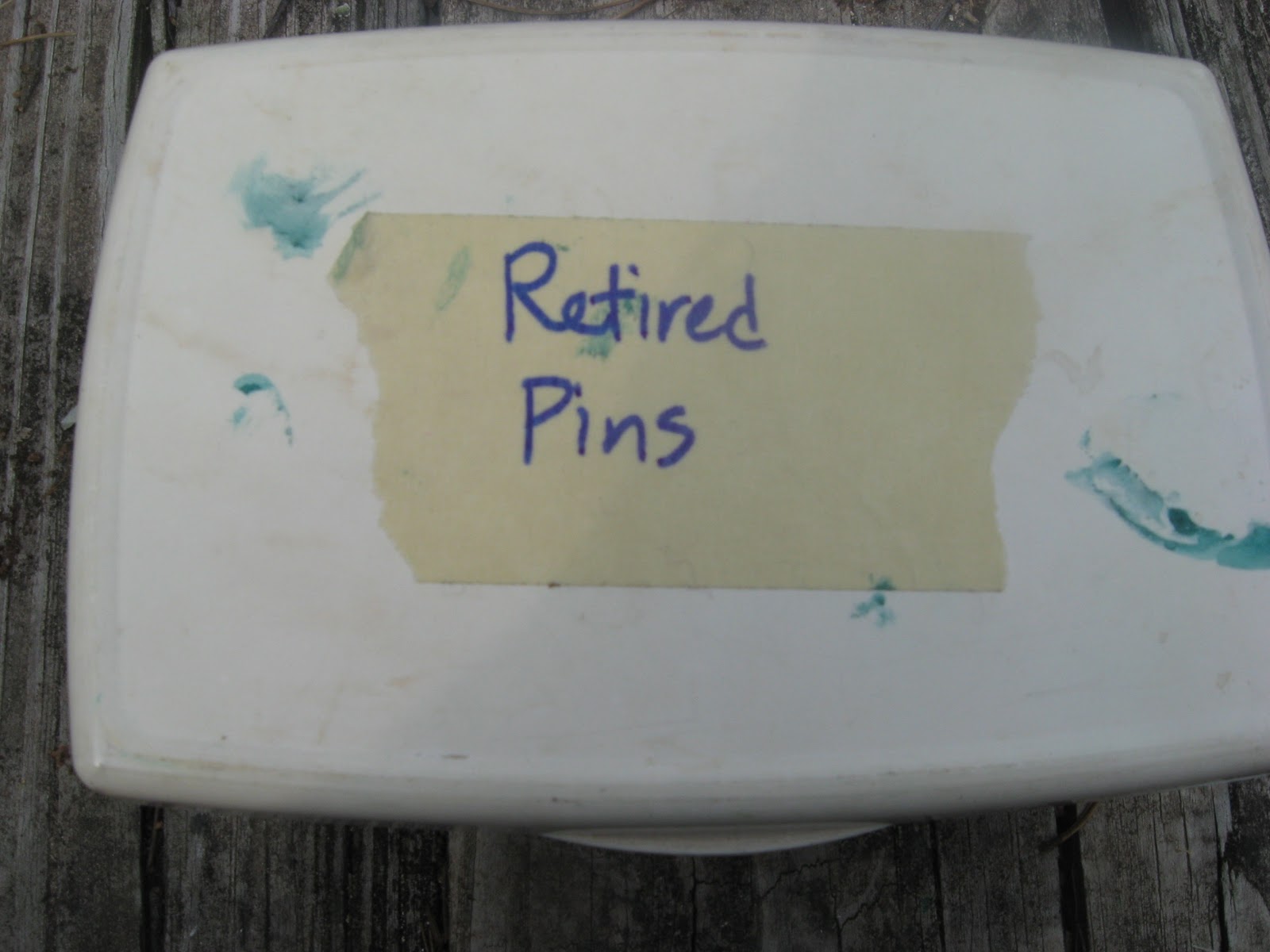
The other day I got myself a container of 500 brand new pins and retired the old ones. The old ones were bending under the tasks I demanded of them, no longer sharp enough to go through many layers of fabric and fiber. But I didn't want to discard them altogether...so I found an empty baby wipes box from when Lucia, 19, was in diapers, and made it a home for retired pins.
Retired pins. What a concept.
But I can use these no-longer-sharp pins for low-stress jobs, like holding fabric to foamcore board during sunprinting. Which is why there's green paint on the lid of the retired pins box.
In today's other nutty activities, I painted the scales of pine cones of a Norway spruce in our yard. I'd already preserved these scales in a mix of hot glycerine and water. As they dried, they lost some of their green coloration, so I sought to preserve that today by painting their ends with Pebeo Setacolor paint in light green.
All the better to add them to a fabric rendition of this photo:
I'm calling it Deconstruction.
And you know what else? I made another sleeve for a noodle today.
Yessss!
Retired pins. What a concept.
But I can use these no-longer-sharp pins for low-stress jobs, like holding fabric to foamcore board during sunprinting. Which is why there's green paint on the lid of the retired pins box.
In today's other nutty activities, I painted the scales of pine cones of a Norway spruce in our yard. I'd already preserved these scales in a mix of hot glycerine and water. As they dried, they lost some of their green coloration, so I sought to preserve that today by painting their ends with Pebeo Setacolor paint in light green.
All the better to add them to a fabric rendition of this photo:
I'm calling it Deconstruction.
And you know what else? I made another sleeve for a noodle today.
Yessss!
Wednesday, August 31, 2011
Fiber Harvest: Hanging our Show
Posted by
Diane Cadrain
Today the members of the Connecticut Fiber Arts Collective met at the Noah Webster branch of the West Hartford Library, 20 So. Main St., West Hartford, CT, to hang our show, Fiber Harvest.
And what a show. Take a peek at our work!
| L-R, Carol Vinick, Rosalind Spann, David Wright, and a library patron |
| How proud are we of our show, and of working together to hang it? L-R, Jeanne Landry Harpin, Mary Lachman, Diane Cadrain, Diane Wright, Carol Vinick, Rosalind Spann, Carol Eaton |
| L-R, Harvesting Wheat by Carol R. Eaton; Grapeology by Karen LoPrete; and Harvest Moon by Mary Lachman |
| L-R, Harvest Moon by Diane Wright; How does your Garden Grow by Carol R. Eaton; Papa's Greens Harvest by Rosalind Spann |
| Quilts by Diane Wright. Top: Windfall. Bottom: Harvest of Leaves. |
| Hanging Grapes by Diane Cadrain |
| Autumn's Bounty by Jeanne Landry Harpin |
| Grape Harvest by Carol Vinick |
| The Fruits of our Labor by Carol R. Eaton |
| And here's Laura Crosky, the West Hartford Library staff member who made our show possible. Thanks, Laura! |
Tuesday, August 30, 2011
Now I'm making sleeves for noodles?
Posted by
Diane Cadrain
Thoreau said we're become the tools of our tools, and I tend to think he's right, especially last night, when I constructed sleeves for noodles.
Sleeves for noodles? By "noodle," I mean the styrofoam kind that kids use when they're swimming. It turns out that noodles are very useful for the storage of quilts. You wrap the quilt around the noodle, pin or tie it shut, and it's safe.
But first you have to cover the noodle with cloth--a sleeve, if you like, or a sock, or even a condom. Call it what you will, it's a sheath for the noodle.
Last night I cut up an old bathroom curtain that was in my stash and made sleeves for noodles.
What would Thoreau say?
Sleeves for noodles? By "noodle," I mean the styrofoam kind that kids use when they're swimming. It turns out that noodles are very useful for the storage of quilts. You wrap the quilt around the noodle, pin or tie it shut, and it's safe.
But first you have to cover the noodle with cloth--a sleeve, if you like, or a sock, or even a condom. Call it what you will, it's a sheath for the noodle.
Last night I cut up an old bathroom curtain that was in my stash and made sleeves for noodles.
| Here are 2 of my quilts, wrapped around their newly-sheathed noodles. |
What would Thoreau say?
Sunday, August 28, 2011
What do you do when you find end caps? Save them for end times.
Posted by
Diane Cadrain
Today I took advantage of a period of enforced home confinement, courtesy of Hurricane Irene, to clean out and reorganize my tiny work space. It's a pain in the buttsky job, but one I knew I needed to do to get ready for some upcoming obligations: in November and December, a group show with other members of Women Against the Grain at the Farmington Valley Art Center; and in May 2012, my own solo show at UConn Health Center.
I want to create a series of smaller works for the Farmington Valley Art Center and a few dramatic, larger works for the UConn Health Center.
To clear the decks for that upcoming body of work--stand by for a preview--I needed to focus on the efficiency of my use of my limited storage space, inventorying the contents of my system of cabinets and boxes, consolidating like with like, and reviewing my stock of supplies like Pebeo Setacolor paints and finely woven pima cotton. By doing that, I minimized the amount of distraction created by clutter, disorganization, and supply interruptions.
Oh, I was virtuous.
In the process, I looked through my box labeled Notions, the contents of which include shower curtain rings, drapery hooks, cording, elastic, and velcro.
Why do we call miscellany like this "notions"? The departed department stores of the sixties, like the Edward J. Malley Company in New Haven, where I shopped in my high school and college years, had notions departments where customers could find things like emergency sewing kits and padded hangers. Why notions?
The Oxford English Dictionary, of which I have a two-volume set from my days as a graduate student at Ohio State, gives this as definition #9: "articles or wares of various kinds, forming a miscellaneous cargo," using the following quotation as an example of that usage: "A cargo of fresh provisions, mules, tin bake-pans and other notions," Richard Henry Dana, Before the Mast.
Now that I cleared that up.
Here's a peek at some of the goodies I'm planning on making over the next few weeks and months:
How about this little display? This will be for the Farmington Valley Art Center Show. I'll print this photo on fabric, make it the centerpiece of a quilt, and call it Deconstruction. Why not? The deck is full of squirrel detritus from our Norway spruces: partially-eaten cones and their scales.
Just for fun, I'm going to add some real scales from the cones. To that end, I gathered a bunch of them the other day and dropped them into a solution of warm glycerine and water.
and I'm drying them out on a piece of paper towel:
Once these cone scales are dry, I'll paint them with polyurethane before using them in the quilt. I'll puncture each one with an awl and sew them on by hand. They'll dribble down from the pile of scales in the photo.
For the UConn Health Center, I'm planning a group of larger works, such as a series called Penwood Long Blue Shadows, which will include images such as the following:
I'm going to make the long blue shadows with painted stiffened cheesecloth. I can hardly wait.
Anticipation of projects like these gave me the incentive I needed to get through this major workspace inventory and upheaval today. In the process, I came across a few mystery items, like these white plastic objects:
Who can tell me what they are? They look like some sort of end caps.
I think I'll save them for end times.
I want to create a series of smaller works for the Farmington Valley Art Center and a few dramatic, larger works for the UConn Health Center.
To clear the decks for that upcoming body of work--stand by for a preview--I needed to focus on the efficiency of my use of my limited storage space, inventorying the contents of my system of cabinets and boxes, consolidating like with like, and reviewing my stock of supplies like Pebeo Setacolor paints and finely woven pima cotton. By doing that, I minimized the amount of distraction created by clutter, disorganization, and supply interruptions.
Oh, I was virtuous.
| Inventoried, reorganized, streamlined, consolidated |
| Order imposed |
Why do we call miscellany like this "notions"? The departed department stores of the sixties, like the Edward J. Malley Company in New Haven, where I shopped in my high school and college years, had notions departments where customers could find things like emergency sewing kits and padded hangers. Why notions?
The Oxford English Dictionary, of which I have a two-volume set from my days as a graduate student at Ohio State, gives this as definition #9: "articles or wares of various kinds, forming a miscellaneous cargo," using the following quotation as an example of that usage: "A cargo of fresh provisions, mules, tin bake-pans and other notions," Richard Henry Dana, Before the Mast.
Now that I cleared that up.
Here's a peek at some of the goodies I'm planning on making over the next few weeks and months:
How about this little display? This will be for the Farmington Valley Art Center Show. I'll print this photo on fabric, make it the centerpiece of a quilt, and call it Deconstruction. Why not? The deck is full of squirrel detritus from our Norway spruces: partially-eaten cones and their scales.
Just for fun, I'm going to add some real scales from the cones. To that end, I gathered a bunch of them the other day and dropped them into a solution of warm glycerine and water.
and I'm drying them out on a piece of paper towel:
Once these cone scales are dry, I'll paint them with polyurethane before using them in the quilt. I'll puncture each one with an awl and sew them on by hand. They'll dribble down from the pile of scales in the photo.
For the UConn Health Center, I'm planning a group of larger works, such as a series called Penwood Long Blue Shadows, which will include images such as the following:
I'm going to make the long blue shadows with painted stiffened cheesecloth. I can hardly wait.
Anticipation of projects like these gave me the incentive I needed to get through this major workspace inventory and upheaval today. In the process, I came across a few mystery items, like these white plastic objects:
Who can tell me what they are? They look like some sort of end caps.
I think I'll save them for end times.
Thursday, August 25, 2011
Salute to Grandpa Ott
Posted by
Diane Cadrain
Grandpa Ott comes back to haunt me every year, so vigorously, and so faithfully, that despite my efforts to eradicate him, I finally have to give up and salute the blind life force that drives his flower.
Grandpa Ott is the man who gave his name to a lush purple variety of morning glory: according to the lore of the gardening world, John Ott was a Bavarian immigrant who passed this variety of morning glory down to his granddaughter, Diane Whealey, in 1972. The deep purple flowers inspired her to start the Seed Saver's Exchange, a nonprofit organization dedicated to saving and sharing heirloom seeds.
I planted Grandpa Ott morning glories once, only once, in my garden--years ago. That year, I wanted a bed of annual vines, so I erected bamboo teepees and on them grew hyacinth bean, cardinal climber, and Grandpa Ott morning glories. The next year, I went on to try something else, and then something else.
Still, each year, toward the mid to end of the summer, I'd see Grandpa Ott surfacing in my garden, and I'd pull him out every time. Inevitably, every year, I would overlook a vine, and a lush purple morning glory would appear between the leaves of plants I'd intentionally planted, its throat painted with five stripes of brilliant magenta.
Here he is in September, 2010, overtaking santolina and sweet basil. How can I begrudge him those luscious flowers, even though the vines that carry them are so invasive?
Still, this year, I set out as usual to pull out the Grandpa Ott seedlings, not wanting them to overtake my carefully-planted silver garden, with its catmints and Russian sages. As always, I regretted eradicating the large heart-shaped leaves and the vigorous, twining vines.
This time, I resolved to find another place to put him, and I found it: along the driveway fence, where the available growing medium is asphalty rubble, and rugged weeds like goldenrod grow happily.
I'm so taken with the lush, heart-shaped leaves that I decided to try sunprinting them.
I used this sunprint as a background for a quilt called Salute to Grandpa Ott. I embellished it with still more sunprinted morning glory leaves, each freestanding, backed and wired and inserted into the sunprinted background. I added free-standing morning glory flowers too.
And that's my salute to Grandpa Ott. It was the least I could do.
Grandpa Ott is the man who gave his name to a lush purple variety of morning glory: according to the lore of the gardening world, John Ott was a Bavarian immigrant who passed this variety of morning glory down to his granddaughter, Diane Whealey, in 1972. The deep purple flowers inspired her to start the Seed Saver's Exchange, a nonprofit organization dedicated to saving and sharing heirloom seeds.
I planted Grandpa Ott morning glories once, only once, in my garden--years ago. That year, I wanted a bed of annual vines, so I erected bamboo teepees and on them grew hyacinth bean, cardinal climber, and Grandpa Ott morning glories. The next year, I went on to try something else, and then something else.
Still, each year, toward the mid to end of the summer, I'd see Grandpa Ott surfacing in my garden, and I'd pull him out every time. Inevitably, every year, I would overlook a vine, and a lush purple morning glory would appear between the leaves of plants I'd intentionally planted, its throat painted with five stripes of brilliant magenta.
Here he is in September, 2010, overtaking santolina and sweet basil. How can I begrudge him those luscious flowers, even though the vines that carry them are so invasive?
Still, this year, I set out as usual to pull out the Grandpa Ott seedlings, not wanting them to overtake my carefully-planted silver garden, with its catmints and Russian sages. As always, I regretted eradicating the large heart-shaped leaves and the vigorous, twining vines.
This time, I resolved to find another place to put him, and I found it: along the driveway fence, where the available growing medium is asphalty rubble, and rugged weeds like goldenrod grow happily.
I'm so taken with the lush, heart-shaped leaves that I decided to try sunprinting them.
I used this sunprint as a background for a quilt called Salute to Grandpa Ott. I embellished it with still more sunprinted morning glory leaves, each freestanding, backed and wired and inserted into the sunprinted background. I added free-standing morning glory flowers too.
And that's my salute to Grandpa Ott. It was the least I could do.
Subscribe to:
Posts (Atom)